As of May 1, 2026, The Family Partnership will transition its outpatient mental health and school-linked mental health (SLMH) services to partner organizations in the Twin Cities.
We remain committed to mental health care in this community. That means making sure everyone has the information they need to continue accessing care, whether you have been a client with The Family Partnership or newly seeking services.
If you or someone you know needs mental health care
If you are looking for a new mental health provider, the organizations below provide services in the area:
For children and teens (under 18):
- Washburn Center for Children: (612) 871-1454
- Avivo: (612) 752-8000
- CLUES: (612) 439-9671
- African American Child Wellness Institute: (763) 522-0100
- LynLake Centers for Wellbeing: (612) 979-2276
For adults:
- Southside Community Health Services: (612) 827-7181
- Avivo: (612) 752-8000
- CLUES: (612) 439-9671
- Edges Wellness Center: (612) 217-0584
- LynLake Centers for Wellbeing: (612) 979-2276
Have questions? You can reach us at (612) 729-0340 or info@thefamilypartnership.org.
The Family Partnership’s other programs and services continue
- Four Directions Preschool: early childhood education, including our Ojibwe language partnership with Wicoie Nandagikendan
- Developmental Therapies: supporting children’s growth and learning
- Family Home Visiting: helping parents build skills and connections during the early years
- Anti-Sex Trafficking Services: supporting survivors and working to end exploitation in our community
- Free Monthly Health Fair: offering vaccinations, HIV and STI testing, coordinated housing entry assessments, and insurance navigation
- Family Resource Center: a new community space where families can connect with a range of services and resources, including support from TFP and community partners
Our work has always been rooted in healing, and it always will be.
A note from our leadership
“I am deeply grateful to our behavioral health team for the care and dedication they have brought to this community. This transition reflects our commitment to doing right by our clients and staff—and to building a TFP that can serve families for generations to come.”
— Emily Larson, President and CEO
What the Sugar Bush Has to Do With Preschool
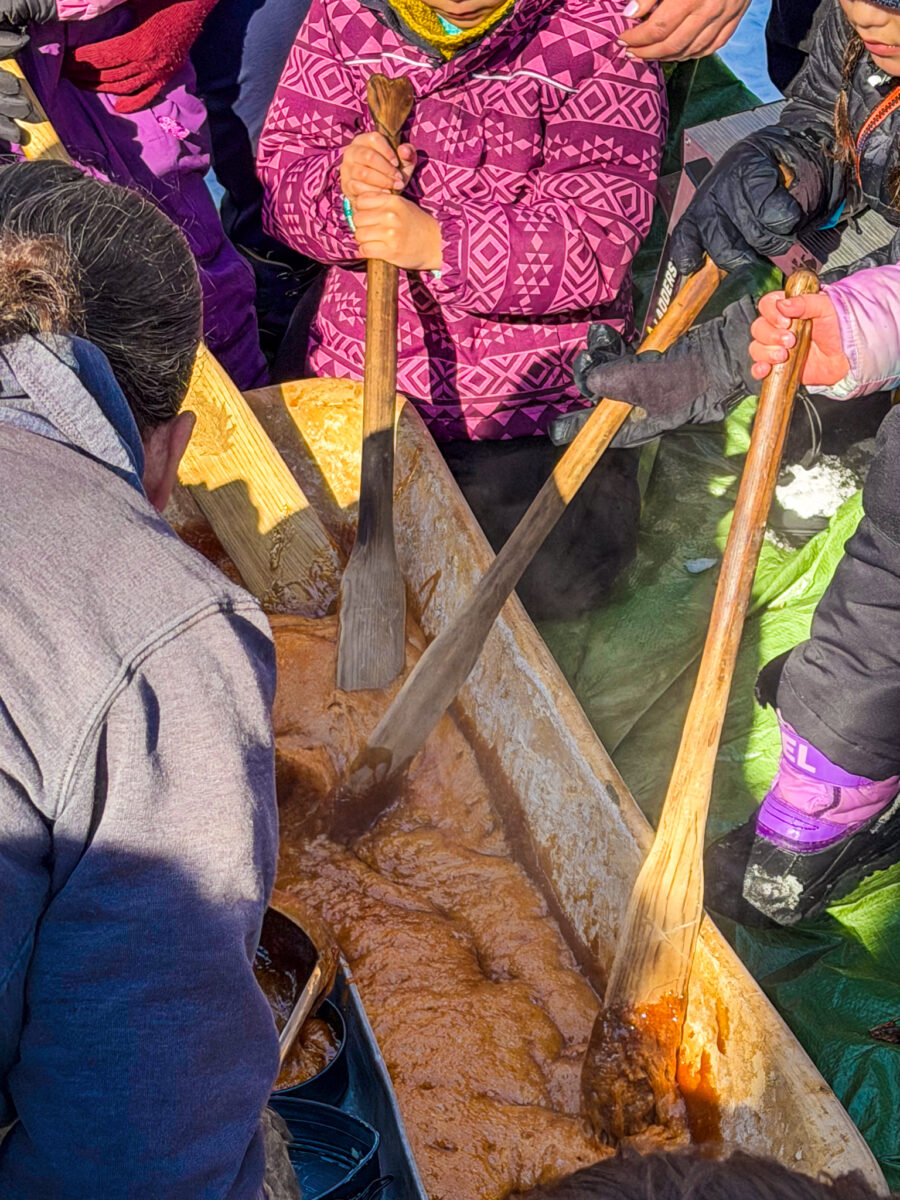
It’s mid-March at Porky’s Sugarbush, where woodsmoke mingles with the sweet smell of heated maple sap. Candy-colored buckets hang from gray-brown tree trunks, catching a slow drip of sap. Nearby, children’s voices rise and fall in laughter and language that has been spoken on this land for thousands of years.
This is a learning day for the Ojibwe immersion classroom from Four Directions Preschool, led by our partner Wicoie Nandagikendan. Right now, young learners from Minneapolis have the opportunity to run through the snow, mix maple syrup into soft sugar, and offer tobacco to the maple trees in thanks for their gifts. It’s the Anishinaabe new year: a time to celebrate the generosity of the land and the ways all living things depend on one another.



How Wicoie Nandagikendan Is Raising the Next Generation of Ojibwe Speakers
Whether on East Lake Street or at the sugar bush, young children at Four Directions Preschool are always learning. Their most important lessons happen in relationship: by weaving care and knowledge together.
That is exactly what Wicoie Nandagikendan brings to Four Directions. Founded in 2006, Wicoie Nandagikendan is the first Indigenous urban preschool immersion program in Minneapolis and one of the only Ojibwe language immersion early childhood programs in the country. Ojibwemowin is more than a subject on the schedule. It is the language through which children experience everything, inside the classroom and out.
For children in Wicoie Nandagikendan’s classroom, learning in Ojibwe means deepening the way they relate with the world and sustain connections to family and community across time. With fewer than 25 first-language Ojibwe speakers remaining in the United States, that connection is both precious and urgent.
“Every child in this classroom has the potential to be a fluent Ojibwe speaker, and many already are,” says Liz Zinsli, lead teacher at Wicoie Nandagikendan. “We are creating a pathway for the language to live on through the children.”


The Benefits of Ojibwe Language Immersion for Young Children
Research confirms what families already know: children in immersion programs do more than keep pace with their peers—they thrive. Bilingual children develop stronger executive function skills, which include the ability to focus, think before acting, solve problems, and regulate impulses. They are more flexible and creative thinkers, better at reading context and responding to the needs of the people around them. Learning a second language, it turns out, makes children better at being human with each other.
For Native American children, the benefits run even deeper. The right to be educated in their own language is one that American Indian communities have had to fight to reclaim. Its restoration is still recent, still unfolding, and still urgent.*
What is happening in Wicoie Nandagikendan’s classroom is part of that reclamation. And on a spring morning at Porky’s Sugarbush, it looks like children running through the snow, singing songs in Ojibwe, and getting a taste of fresh maple sugar.

How Four Directions Preschool Builds on Family and Cultural Strengths
At Four Directions, honoring family and cultural strengths lives at the heart of The Family Partnership’s two-generation approach. Supporting a preschooler means supporting their whole family: with the unique gifts they’ve inherited and the unique visions they hold for the future. “South Minneapolis is home to a rich mosaic of cultures, languages, and lived experiences,” says Sarah Werner, Senior Director of Four Directions Preschool. “And that diversity is one of our community’s greatest strengths. Honoring that means being intentional: hiring staff who reflect the community, celebrating the strengths every child and family brings, and being a true partner to families in addressing whatever stands between a child and their full potential.”
Honoring [each culture] means being intentional: hiring staff who reflect the community, celebrating the strengths every child and family brings, and being a true partner to families in addressing whatever stands between a child and their full potential.
Sarah Werner, Senior Director of Four Directions Preschool
When a child knows their language, practices, and place in a long lineage of people who came before them, they hold something that will carry them for a lifetime. The four-year-olds learning Ojibwe today will grow up to be parents and elders themselves, passing on to the youngest generation what was passed on to them. At Four Directions, we are honored to provide a home where that continuum of knowledge is nurtured, and where the gifts of the land, family, and community form the foundation that everything else is built on.
*Learn more about the history of Native American boarding schools and ongoing healing efforts at the National Native American Boarding School Healing Coalition.
Follow the story
On any given day, the Instagram feeds of Four Directions Preschool and Wicoie Nandagikendan share the joys of our early childhood programming. Follow both to stay close to the children, families, and community at the heart of this work.
This January marks National Human Trafficking Prevention Month, and understanding how sex trafficking works matters urgently right now. ICE raids in Minneapolis are pushing exploitation underground while funding cuts destabilize safety nets. Everyday people are our strongest defense in recognizing trafficking and connecting people to help.
There’s reason for hope. Mikki Mariotti directs The Family Partnership’s anti-sex trafficking program PRIDE. After 30 years of working with people who have experienced trafficking, she joined researchers from Clemson University, the University of Minnesota, Northeastern University, and RTI International as a subject matter expert in a groundbreaking project that did something different: it brought survivors onto the research team as experts.
Mariotti and others in the survivor-centered advisory group shaped research questions, challenged assumptions that don’t match reality, and ensured trauma-informed processes throughout. Their goal: make academic findings useful for practitioners, not just other academics.
“Everyone on the team valued one another’s knowledge,” Mariotti says. “It was a level playing field where we all learned and taught each other. That made the research actually useful in the real world.”
The team also created a toolkit for other survivors engaging in research. Their work revealed numerous insights about how trafficking networks operate. Below, we’ll share five that are particularly relevant to Minnesota communities right now and practical ways you can help.
1. ICE presence puts everyone experiencing trafficking at greater risk
Nearly 3,000 ICE agents are now operating in Minneapolis, almost three times the size of the Twin Cities’ police forces combined. This affects everyone experiencing sex trafficking in our community, not just immigrants.
Here’s why this matters: these federal agents have been told they have absolute immunity. That means limited accountability for their actions. For people already in exploitative situations, this creates serious safety concerns.
The concerns are based on documented patterns. An ICE agent was indicted on charges of trying to sexually exploit a minor here in Minnesota. In Louisiana, an ICE officer pleaded guilty to sexually abusing a woman in detention, repeatedly, over many months. And right now, reports are coming from our own Minneapolis community about civil rights violations and abuse of power during ICE operations.
For people being trafficked, this changes the calculation about seeking help. They’re already being controlled and threatened. Now reaching out for help means approaching agents who may not be held accountable for misconduct. For immigrants or anyone who might be seen as an immigrant, there’s added concern about detention or deportation.
Traffickers understand this dynamic and use it to maintain control, threatening people with ICE contact when fear of authorities now feels justified.
What you can do:
- Share know-your-rights resources from organizations like the Immigrant Law Center of Minnesota
- Offer practical support to neighbors that reduces vulnerability: rides, groceries, childcare. Fewer pressures mean less leverage for traffickers
- Connect anyone experiencing exploitation to PRIDE at The Family Partnership or the National Human Trafficking Hotline: 1-888-373-7888

2. Someone you know might be at risk for human trafficking right now
Many people imagine trafficking happens somewhere else, to people unlike them. But exploitation is happening in our community right now—in schools, workplaces, apartment buildings, and faith communities we share.
Economic hardship can push people to seek extra income in risky situations. Stress and instability can lead to substance use that creates new vulnerabilities. Your neighbor, someone at your child’s school, or a person you sit next to at church might be facing these pressures right now.
Trafficking doesn’t usually begin with kidnapping or force. It begins with offers that sound like help: a place to stay, a ride to work, help paying bills, quick cash. And it often begins in everyday relationships, with someone you might already know.
By the time the “help” comes with strings attached, leaving can be genuinely dangerous. Traffickers rely on isolation, threats, and fear to maintain control. When someone feels they have no safe options, abuse can go unseen for months or years.
When we show up for our neighbors, our relationships become a protective barrier that makes exploitation harder.
Watch for these signs:
- Someone whose living or work situation suddenly changes
- A teenager with an older “boyfriend” who controls their phone
- A coworker who seems fearful or controlled by someone else
- Someone who expresses fear of authorities, even when they need help
3. Some people being trafficked are also forced into theft
When ICE raids intensify, two things happen. The heightened enforcement makes commercial sex riskier. And buyers—unwilling to risk arrest or deportation themselves—pull back. This reduces demand and cuts into traffickers’ income.
Traffickers pass the pressure on to the people they are exploiting. They force people into other criminal activity that draws less attention and doesn’t depend on buyers willing to take risks. Research shows theft increases by 10-40% during disruptions like this.
This matters because as trafficking goes underground, you’re more likely to encounter someone being trafficked through theft or fraud than through obvious signs of sexual exploitation. The teenager shoplifting may be experiencing trafficking. The person caught with drugs may be controlled behind the scenes. The individual committing fraud may be too terrified to explain what’s really happening.
If you work in retail, healthcare, education, or criminal justice:
- Watch for repeated theft where the story keeps changing
- Notice if someone seems controlled or fearful
- Ask: “Are you safe?” or “Is someone making you do this?”
- Connect them to resources: 1-888-373-7888

4. Your conversations can help disrupt human trafficking
ICE raids and funding cuts are increasing stress and isolation while cutting access to housing, mental health services, and substance abuse treatment. When these systems fail, traffickers fill the gaps, offering what seems like help, then using that dependency for control.
Immigrants and those who may be profiled face compounded risks: fear of deportation can make accessing services or reporting abuse more dangerous than staying trapped.
Communities that speak up can help break this cycle. Your voice matters in addressing these root causes.
Make your voice count:
- Share the 4-minute research video explaining how trafficking really works
- Talk about how fear of enforcement pushes people toward exploitation
- Advocate for stable housing, accessible mental health care, and economic support that reaches all community members
When communities understand how systemic failures and enforcement fears create vulnerability to trafficking, we can address the conditions that make exploitation possible.
5. Coordinated action creates lasting change
Minnesota’s approach to trafficking prevention spans a statewide network of partners providing services, housing, shelter, outreach, and support. The Family Partnership is part of this network. Ian Smart, PRIDE Program Supervisor, describes the people we serve: “Our participants are strong people that are really just looking for love and support and for guidance as well.”
Smart also names what stands in the way: “Access to resources is one of the barriers, and it’s a lack of knowledge. The more organizations there are like this, the better things we can do to help change the tides.”
The research confirms this: implementing three or more anti-trafficking interventions together has exponentially more impact than single efforts alone.
Long-term community safety requires:
- Survivor support and leadership
- Public awareness and education
- Policy advocacy
- Economic stability and access to basic needs
What you can do:
- Take care of your own well-being so you can stay present and support neighbors safely
- Keep talking with friends, family, and community. Connection reduces isolation and helps prevent exploitation
- Support organizations that address immediate needs while building systemic change
Why this matters now
Sex trafficking happens in Minnesota, in our communities. Right now, ICE raids and cuts to basic services are making more people vulnerable while pushing those currently being exploited deeper into the shadows. But when we understand how trafficking actually works and listen to people who have survived it, we can prevent it more effectively, spot it sooner, and help people rebuild their lives.
“When we center survivor expertise, we create solutions that actually work,” Mariotti says.
This January, support survivor-centered solutions. The Family Partnership’s PRIDE program provides long-term, survivor-led services and advocacy. Learn more about our anti-sex trafficking work and how you can help.
The Family Partnership is excited to welcome Emily Larson as the agency’s next President and CEO beginning July 1. Emily is a seasoned and trusted executive leader with clear values and tenacious dedication to families and community. Emily has two decades of experience setting long term vision, building high-impact teams, and establishing actionable steps to make meaningful change.

Most recently, Emily served as mayor of Duluth, Minnesota, where she managed complex budgets, fundraised millions of dollars for city improvements, and built deep relationships with stakeholders to coalesce around shared goals. Twice elected, she championed policies to support residents and improve the well-being of the community.
Emily is a Twin Cities native who started her career in social work. She credits her family as the origin of her passion for equity. “I grew up in St. Paul with a family of people who were doggedly justice minded. My aunty worked at TFP back when it was Family & Children Services. So, my first interaction with the organization was providing childcare for family meetings that my aunt facilitated.” Later, in Emily’s 12 years as a social worker, she partnered with families who had low or no income, who were experiencing housing instability, and who were navigating mental and chemical health issues.
Emily cites these experiences in direct service as her motivation for addressing systemic injustice at a larger scale. She pursued policy development, legislative advocacy, and organizational leadership as “preventative medicine” for the economic and racial injustices that impact families. She sought public office to promote housing justice and job cultivation, among many other social supports and strategies. Her goal in public office was to amplify the voices that are “underappreciated, undervalued, and pushed to the margin.”
“Emily has the ideal combination of operational expertise to lead TFP through the issues we face and she’s a visionary who can take TFP to great heights.”
Nima Desai, The Family Partnership Board Chair and Search Committee Member
TFP, like many nonprofits, faces an unpredictable political and financial landscape. Nima Desai, Board Chair and Search Committee member said, “Emily has the ideal combination of operational expertise to lead TFP through the issues we face and she’s a visionary who can take TFP to great heights.” We are grateful to CohenTaylor Executive Search Services for recruiting Emily and guiding the board through the search process. Emily has the experience, persistence, and grounded optimism necessary to stabilize TFP during this challenging time. When asked about this next chapter, Emily said, “TFP is about building power with families, and it has a great reputation in this community. This work needs to continue. There are not many other safety nets for families. The stakes are high. So, let’s get to work.”
“This work needs to continue. There are not many other safety nets for families. The stakes are high. So, let’s get to work.”
Emily Larson, New President and CEO of The Family Partnership
Emily Larson has 12 years of experience in public service, first as Duluth City Councilor & Duluth Economic Development Authority Commissioner, then as Duluth Mayor. She also has 8 years of experience as a non-profit consultant and 12 years of experience as a social worker & emergency outreach worker. Emily’s extensive board service includes local organizations like YWCA, Center City Housing, and Arrowhead Regional Development Commission. She has participated at a State level in the Governor’s Housing Task Force, Young Women’s Initiative of MN, MN Mayors Together and regionally and nationally with Great Lakes and St Lawrence Seaway Initiative Cities, SeaGrant, Climate Action Municipalities, National League of Cities, and Energy, Environment and Natural Resources.
Emily graduated with a bachelor’s degree in social work from the College of St. Scholastica and later earned a Master of Social Work from the University of Minnesota-Duluth. She is married to Doug Zaun and together they have two sons. In taking on this new role, Emily and Doug will now split their time between Minneapolis and Duluth. In addition to her professional work, she enjoys spending time outdoors, trail running, mountain biking, and rock climbing. She loves reading, tending to her many plants, talking to her sister on the phone, and spending time with her beloved family.
Read the Star Tribune CEO announcement here.
Want to stay connected?
Get inspiring stories, news, and updates from The Family Partnership in your inbox.
Sign up for our newsletter today!
Help The Family Partnership celebrate our exciting new chapter by sharing this post!
Click the links below to share with your network.